United States: after the November 3 midterm elections
Exclusive interview with Nate Knauf, member of the National Electoral Committee of the Democratic Socialists of America (DSA) and secretary of the DSA’s Atlanta chapter.
- International
What is your perspective on the results?
At the federal level, the results are far better for the left and far worse for Trump and the conservatives and fascists, than anybody expected. People were expecting a backlash. They were optimistic that there would be this repudiation of the Trump administration over the past two years. But he results were far more in favor of the Democrats than anybody was expecting was possible.
In the state of Texas for instance, which is historically very conservative, the Democrats won the Senate seat and the governorship, which is the executive for the state government. The same in Georgia : Democrats won the governorship and control of the state house.
The state senate will still be held by the Republicans, by one vote, because of the gerrymandering, where they have drawn districts that disenfranchise people and that are basically rigged to ensure that the Republicans can still win even if they lose the popular vote. As a result, in a number of states, there will now be a conflict between the governor, who has a popular mandate with large margins to govern, and the legislature.
Gerrymandering is a term for when elected officials draw the districts on the district map. In our country, we do not have proportional representation. It’s one district, one representative. The winner-take-all in each district. They draw the districts in such a way that they pack people in. The Democrats might be in the majority statewide, but they make a bunch of districts where the Democrats are packed in, 90 or 95% Democratic districts, and then they make a bunch of districts that are slimly Republican, 55 or 60 percent Republican. They draw the maps in a way so that even if they lose the vote, they will still get the majority of the seats.The Democrats are making huge gains despite the intense gerrymandering. There used to be voting rights laws that ensured, in the South, where there is a large African American minority population, rights from the civil rights era that were won by Martin Luther King Jr. and the civil rights movement in the 1960s. They said that when they drew the maps for these districts, they would have to have majority-minority districts, so that Black voters in the South would have districts where they could elect Black representatives. The Supreme Court struck down that law from 50 years ago and said it’s unconstitutional. They voided the law to allow the Republicans to redraw all of the congressional districts for the US Congress, to rig the elections further and try to give the Republicans more seats, because they were anticipating the backlash. The Republicans tried to redraw the maps, and they tried to challenge people’s eligibility to vote. |
Since the election of Trump, the establishment of the Democratic Party was not very vocal in opposing Trump. How do you understand the results today, and how did DSA make a difference?
There has been a big frustration with the Democratic Party leadership, because they have not been as combative or oppositional with the Republicans as the base and voters would want. DSA won a lot of primary elections in the spring, where DSA and other progressive candidates defeated many conservative, more moderate Democrats in the candidate selection.
The US is a very big country, so DSA is relatively decentralized, and there are different standards from chapter to chapter on how they define an endorsement and what the criteria are for somebody to be an endorsed candidate. There are going now to be eight members of Congress who are DSA members and endorsed by their chapter. That includes three in New York City, two in Detroit, and then one each in Philadelphia, Denver and Los Angeles.
There are also a number of other progressives in office who are not DSA members but are going to be fellow travelers.
There are also people like Summer Lee and Ilhan Omar in Minneapolis. Ilhan Omar is a friend of DSA. Just a few weeks ago, the federal government raided her home to search for documents. She is a Somali immigrant. The Trump administration has been trying to build a case to argue that her citizenship paperwork from long ago was invalid, so that they can strip her of her citizenship and remove her from office. This is the kind of thing the administration is doing. The Trump administration has been uniquely violent and authoritarian over the past two years, and there has been a huge backlash to that. Ilhan a just been re-elected.
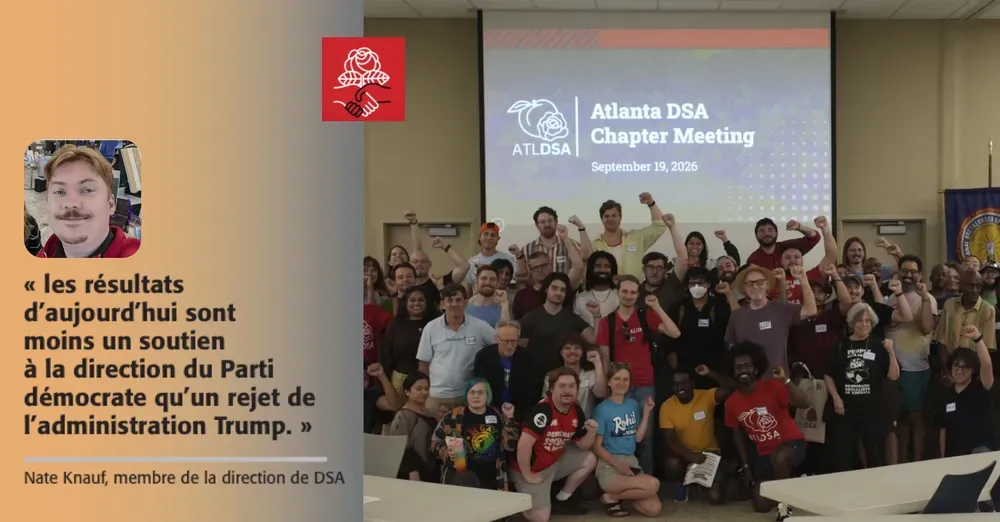
I would take the results today less as an endorsement of the Democratic Party leadership and more as a repudiation of the Trump administration.
I would take the results today less as an endorsement of the Democratic Party leadership and more as a repudiation of the Trump administration. The Republicans were unable to motivate their base to turn out, and there was extremely high enthusiasm from Democratic voters as well as many independent voters. In the US, the more moderate or independent voters who swing from party to party between elections overwhelmingly went to the Democrats.
Looking at the results, it isn’t a realignment where one part of the country switched to the Democrats, or young people switched, or old people switched, or Black voters or white voters. Every single demographic, every part of the country, every constituency moved to the Democrats by about 10 percentage points. That’s a lot, and it’s pretty uniform across the country. There’s been a huge swing.
There were a lot of concerns about violence on election day yesterday. ICE, the Immigration and Customs Enforcement agency, which has become a sort of militia, secret police for the administration, posted on social media a threat saying: “if you vote illegally, we will find you. We will track you down, arrest you, and prosecute you. There will be no escape”. This was a government statement, directly threatening and intimidating people from voting.
Despite all of these threats, and despite the anti-democratic nature of the election system, where even if the Democrats get a majority, the seat share is biased toward the Republicans, the popular mobilization against the administration was so massive that it overcame all of these bureaucratic obstacles to still win a very large majority: something like 55 Senate seats out of 100. The margin in the US House of Representatives will be about 250 to 180, so a 70-seat majority, something like 60% of seats going to the Democrats.
Comparing this to recent elections, this is the biggest landslide margin of victory to happen in the United States in something like 30 or 40 years, since the 1980s or 1990s. There has never been a federal election with a result this large, and this is despite all of these obstacles in terms of the anti-democratic nature of the system, and also, in more recent years, the intense amount of corporate money flooding into elections because of the unlimited ability of corporations to spend unlimited money on elections.
There has never been a federal election with a result this large, and this is despite all of these obstacles in terms of the anti-democratic nature of the system
Trump was talking about trying to contest the election results. A lot of people were bracing for some kind of January 6-type situation if it was close, but these results are so big that Trump has conceded defeat, and it looks like the results will be largely respected.
What about the trade unions?
Where I’m from, in Georgia, the trade union movement is very weak, but the trade unions are still very strongly allied with the Democratic Party all around the country. Even in Atlanta, which is a historically Republican area, the Democrats had their victory party last night at the Hyatt Regency hotel, because it’s one of the few union hotels in the city of Atlanta. In the Democratic Party in Georgia, they force all of the candidates to print their literature with union printers. So even in the more conservative areas, the Democratic Party is pretty tied to the trade unions.
In the more blue states, the states with higher union density, the trade union movement is much more involved in the elections. The UAW, United Auto Workers, was very influential in getting Abdul El-Sayed to win the Senate election in Michigan, because Detroit is the home of the car manufacturing industry in the United States. The UAW has its largest membership in Detroit and Michigan, out of every state in the country, and a lot of older retiree members as well.
Earlier in the year, Abdul El-Sayed beat Haley Stevens in the primary election very narrowly, by 48.5% to 47.5%, a very slim margin, and that was thanks to the UAW. DSA also has candidates like Rashida Tlaib and Donavan McKinney, who are going to be our two members of Congress from Detroit.
The DSA candidates and Abdul El-Sayed were campaigning together, doing joint events and cross-endorsing each other in this election. There was an expectation that Michigan would be more competitive and a more difficult race, and that if Abdul could win that seat, it would mean that progressives could be competitive. Now we have seen that the margins are so big and the political environment has moved so far to the left that it opens up a lot of space for progressives and DSA candidates to win in a lot of places that we didn’t think we could win before.
What does this mean for what comes next?
There was a lot of concern that people always raised: if the Democrats nominated a candidate for the next presidential election that’s too left-wing, too progressive or too close to DSA, then they might alienate the moderate swing voters and lose the general election to a Republican. Because of the two-party system, it pushes people to moderate and says you have to make compromises so that you can win the median, the middle voter. But now the middle voter has moved so far to the left and the Republicans have lost so much support that that is much less of a problem. It means that the candidates and the Democrats can move to the left much more without worrying about potentially losing to Republicans.
Because of the two-party system, it pushes people to moderate and says you have to make compromises so that you can win the median, the middle voter. But now the middle voter has moved so far to the left and the Republicans have lost so much support that that is much less of a problem.
So for Alexandria Ocasio-Cortez potentially running for president, that’s a very good sign. A lot of DSA members are now saying: “we need to start the AOC campaign now, she needs to announce today”.
All of her concern has been electability: can she win the general election in a head-to-head against JD Vance or Marco Rubio? But with the results that have happened tonight, if we expect that mood to continue to 2028, the Republicans will be so unpopular that basically any Democratic candidate could win in 2028. It’s now extremely likely that the Democrats get the presidency in 2028, and not just the presidency.
A big criticism that DSA has of the US Constitution is that we have all these extremely anti-democratic systems of elections.
A big criticism that DSA has of the US Constitution is that we have all these extremely anti-democratic systems of elections. In the Senate, California has something like 40 million people and Vermont has like 650,000 people, and despite one state having 40 times as many people, they both get one senator and one vote. So in the Senate, the small states, which lean conservative, have a hugely disproportionate amount of votes. The Republicans have a majority despite having the support of a minority of the country.
In the Senate they also have a rule called cloture, or the filibuster. In the parliamentary procedure, the motion to end debate and call a vote on something requires 60% of senators. There are no limits on debate, so if you’re really strongly against a bill you can just get up and keep speaking and stop the vote from happening. Unless you have 60%, you can’t end the debate. This has been used over the years: a senator will get up there, they will rotate people out, and they will keep speaking for days and days to stop a vote from happening. You need 60% to end the debate and call a vote.
That has meant that even when the Democrats have had 51 or 52 seats in the Senate, they have not been able to get over the 60-vote threshold to end debate and call the vote on certain issues. So there has been a push from the progressive left and DSA to say that we need to abolish this rule. We need to abolish the filibuster, because all these matters should be decided by 50 percent, not 60 percent. We have the majority in the country, so we should be able to say what the policy is.
Previously the Democrats had 50 or 51 votes, but they had one or two senators who opposed ending the filibuster. Some moderate Democrats were basically saying: well, this helps me, because I get to be the deciding vote on everything. But now, with the Democrats having about 56 votes in the Senate, they could take a vote in January to get rid of this rule.
For decades, the US political system has been characterized by a deadlock where one party controls the House and one party controls the Senate; you can’t really pass anything, you have to negotiate between the two parties, and you can’t do any radical change. But now …
Senate terms are six years, and every two years one third of the seats go up. So we only had one third of the Senate seats up for election last night. They were seats biased toward a more conservative set of states, and they all went Democratic. In 2028 there will be more Republican seats up, in the same places that flipped to the Democrats today. So in 2028 the Democrats may get over 60 seats, and then with the filibuster rule in place they can just vote to end debate.
All of that is to say that, based on these results, the 2028 presidential election will probably go to the Democrats, and they will probably get a very large majority in both houses of Congress, which means that the Democrats are poised to pass really sweeping structural change to the country.
If AOC was president and had a liberal majority in the House and Senate, we could do things like pass legislation legalizing abortion in the entire country. We could repeal right-to-work laws in the US.
Right to work is a labor law in parts of the US. It’s a right-wing law that says every employee has a right to work without being a member of the union. If you work at a union workplace, you do not have to pay union dues ; you can quit the union but still show up to work. They have set up that law to create a free-rider problem and defund unions. Even if unions win a contract, or win a union election to unionize the workplace, the boss can go and tell all the workers: you don’t have to pay your union dues, and they still have to give you all the union benefits and services. You still get the union contracts. They set up these right-to-work laws to pit union members against each other, to incentivize people to basically scab or to quit the union and not pay dues, in order to defund unions and weaken them. That is a major obstacle to union organizing, especially in the South and the conservative areas, because it makes it much harder for unions to get the funding from membership dues to sustain themselves. And so we could get rid of that. |
You will obviously meet some resistance from the traditional Democratic Party establishment.
Yes. I think the next two years will be defined by a civil war within the Democratic Party. As I was saying, in 2028 the Democrats will have the power to enact sweeping change if they want to, and the debate will be: do the Democrats want to enact sweeping change? There will be a big fight with the traditional Democrats, who will say: we’ve won power and now we can just leave things as they are, the fight is over, you don’t have to worry about the Republicans and the fascists anymore. The will want things to stay the same so they can just keep themselves in power first. The progressives and DSA will want to push the Democrats to say: this is a huge mandate, we need to deliver, we need to use the opportunity and seize the moment to pass as much policy as possible and pass as much sweeping reform and structural change.
For DSA there will be a lot of opportunity in the next election cycle. I’ve seen a lot of messages from DSA activists saying we need to run dozens of congressional candidates, a slate of DSA candidates for Congress and for Senate, because there will be a big popular appetite to push the Democrats to do as much as possible.
A major part of why the US is so right-wing is because of the anti-democratic institutions. So tearing down, abolishing and replacing these institutions will be a key issue for the left and the progressives.
I’ve talked a lot about the election system because that’s a big part of our analysis of the US: a major part of why the US is so right-wing is because of the anti-democratic institutions. So tearing down, abolishing and replacing these institutions will be a key issue for the left and the progressives. The DSA platform is calling for things like abolishing the filibuster and abolishing the Electoral College, so that instead of doing the election results state by state, it’s one single national popular vote on who’s president of the United States.
There are other issues that are dividing the Democrats right now, the progressives and DSA versus the moderates and the centrists: military aid to Israel; universal health care, Medicare for All, a single-payer health care program; a Green New Deal and climate change legislation for green energy and for public investment in publicly owned green energy production; union rights legislation.
There’s a piece of legislation called the National Popular Vote Interstate Compact, which is basically a treaty or contract between all the states to say: whoever wins the national popular vote, our state will send all of our delegates to vote for that person. If a majority of states sign on, then it will result in the popular vote instead of the Electoral College. It’s a way around it. Now the Democrats have won control of so many state governments that, if they are pushed by progressives to do it, they could get enough states to sign on so that the next presidential election is decided by national popular vote instead of the Electoral College. That will be a fight in those state legislatures. I think it was Nevada, Pennsylvania, Michigan and Wisconsin, places that used to be Republican-controlled or divided governments, that are now all Democratic. |
Right now it’s up to the states to determine abortion laws state by state. But in 2028, the Democrats could pass a law saying abortion is legal everywhere. They could undo a lot of the gerrymandering. The Democrats are winning in a landslide, but if they rewrite all the maps to be fair maps, if they change it so that we have public financing of elections and ban all the corporate spending in elections, that would shift things even further against the Republicans.
There are very big possibilities for what a Democratic president could do in 2028, which raises the stakes, which makes the Democratic presidential primary in 2028 so much more important.
What does it mean for DSA ?
There’s a big debate in DSA about whether AOC should run for president and whether DSA should support her. Some people in DSA, whom I don’t agree with, argue that AOC has been too moderate on Israel and does not talk enough about Israel-Palestine. She was non-committal on the Iron Dome defense issue a few years ago, where she didn’t want to commit to voting no. But recently, New York City DSA persuaded her to agree to oppose the defensive aid. As of earlier this spring, she is opposed to all military aid to Israel, even their self-defense missile systems, in a total arms embargo. That was a big win for DSA, that we moved her to align with our program on that, and it makes it a lot more likely that DSA would be united around supporting her for president.
I’m in Groundwork Caucus. With a few other DSA caucuses (Groundwork Caucus, Socialist Majority, Bread and Roses, and Reform and Revolution), we passed resolutions saying that we support AOC running for president. DSA’s national leadership hasn’t taken the vote, but it looks like a majority of the national leadership will be supportive of AOC running for president.
Her big decision is that she could run for Senate in New York against Chuck Schumer, who is the current leader of the Democrats nationally. That’s his seat, and he’s very unpopular in New York because of how he has mismanaged the caucus and mismanaged the opposition to Trump. If AOC runs against Chuck Schumer, she would be very likely to win his seat. But it would deprives DSA and the national left across the country of a strong presidential candidate, because she’s our highest-profile member of Congress. She has millions of followers on social media, an international profile, and she’s one of the biggest fundraisers in the country right now. She is extremely good at raising money online, through social media, emails and texting campaigns. She’s very popular, and that makes people think that she would be our best candidate for president, because she could raise the most money and she has the biggest base of support.
DSA has a lot of other members of Congress who are getting elected right now, and we could maybe ask one of them to run for president, but it would be much more difficult, because they’re taking office for the first time in January and would be saying, immediately, we’ll run for president. AOC, by contrast, has now been in office for eight years and is very well known on social media and on TV. She’s been doing a big tour across the country, going to speak at rallies and supporting candidates around the country, making all these appearances. She visited Georgia, she visited Michigan. She was very invested in getting Abdul El-Sayed to win the Michigan seat, and she donated one million dollars to his campaign from her campaign account, which is a very large donation. So she’s been building a lot of alliances and trying to support allies in important places around the country to help with the presidential campaign.
It also seems that Bernie Sanders would be very supportive of AOC running, that he would likely endorse her and support her very strongly to be his successor if she runs, because he is unfortunately too old. If he ran, he would be 87 years old as president, which is very difficult.
If AOC runs, that will also be a big rallying point for DSA, because it will bring in a lot more supporters, voters and volunteers who are drawn in by the magnet of the presidential campaign. They can then be brought in to support the down-ballot candidates, the candidates lower on the ballot, like us running candidates for Congress, for state house, state assembly and local office. DSA is debating the different strategies, and one strategy that I and other people have been advocating is for us to support AOC and then use that energy to elect more DSA members to a lot of local and state offices around the country.
How many members has DSA now ?
We are at 130,000 members.
We redefined membership recently, during the growth period, with a tighter definition of membership. It used to be that if your credit card expired, your membership would last a whole year. We changed it so the membership now lapses 30 days after your credit card expires. About two months ago, that change was made. We lost something like 5,000 members just because of lapsed memberships. But we got them all back, and even more. It used to be that DSA memberships lasted two years, and now it’s only one year, or 30 days if you’re on the monthly dues plan. So DSA has been making the dues definitions stricter, and despite that we’ve been growing a lot.
You also won the mayor of Washington, DC.
Yes, we won the mayor of Washington, DC, and we won the mayor of Los Angeles. The mayor of Los Angeles has also been controversial, again because of Israel. We keep having a lot of debates with people on the right edge of DSA being squishy on BDS or on questions about funding for Israel. With Nithya Raman running for mayor of Los Angeles (she won), there was a big debate in DSA leadership, and they actually took a vote this past weekend. They were doing this at the last second, but the National Political Committee voted on whether to order the DSA Los Angeles chapter to rescind their endorsement of Nithya Raman. The motion failed, but it was 14 to 13. It was very controversial in DSA nationally. But in Los Angeles, the chapter is very invested and supportive, and they voted by over two-thirds to endorse Nithya for mayor. Janeese Lewis George in DC was much less controversial; everybody is very happy about Janeese in DC.
This is a big thing as DSA gets bigger: there are increasing debates about how much centralism there should be, in terms of all DSA candidates having to agree with 100 percent of the national program, versus where DSA candidates will be more moderate or pragmatic or take different positions to get elected. Different sides of DSA want to be more strict or more flexible on which candidates to endorse.
Regardless of that, the trend in DSA over the past couple of years has been toward being more strict on the program requirements for candidates. When DSA really blew up and started exploding in membership in 2017, it was a lot of young people coming in who didn’t have experience in how to run campaigns, so they would have to find, oftentimes, non-DSA progressive candidates to volunteer for and help get elected, in coalitions with other political groups and other non-DSA candidates.
But now it has been 10 years since Bernie ran for president in 2016. I got involved in DSA by volunteering for Bernie’s first campaign in high school. I tried to collect signatures to get him on the ballot, and I was told that because I was 17 years old, I had to be 18 to legally collect the signatures, and I couldn’t sign it. The election was two days before my birthday, so I couldn’t do it. Now I’m 28 years old, on the National Electoral Commission, helping run state legislative campaigns and city council campaigns.
There are a lot of young people who have come up through DSA over the past decade and have a lot more experience. There are a lot more DSA cadre, or DSA militants, running for office. A lot more of our candidates are people who have been activists and organizers in DSA itself, and because of that there is a trend toward the DSA candidates being much more loyal to DSA as an institution and having stricter adherence to the DSA program.
What is the DSA program ?
We just put out a revised and updated “Workers Deserve More” program earlier this year, which is a booklet with our manifesto for the party. It got a lot of attention in conservative media because we were talking about things like ending the filibuster, ending the Electoral College, getting rid of the Senate. The conservatives were horrified; they said : look, they want to destroy America, they want to destroy our institutions. And to that we say:
yes, we want to destroy the institutions, we want a revolution
The DSA candidates have moved more to the left because of that, but there are still people like Nithya Raman, who was first endorsed by DSA in 2020, six years ago. There are some candidates that were supported by DSA when we were more flexible on who to endorse, and DSA has now moved to the left but they are still where they were a few years ago. So the membership is now frustrated at times: why don’t you support our more left-wing policies? Israel has been a big thing on that. Even people on the moderate side, like my caucus, Groundwork, who err on the more flexible side, think that the issue of Israel-Palestine has become so central in US elections, and it’s such a popular position to be pro-Palestine, that there’s no excuse for the pragmatism of not taking a strong line on that. We think it is very important because voters care about it so much. It’s not a niche issue anymore.
How did the war against Iran and the genocide in Palestine contribute to the results today?
It was very important. People in the United States are sick of these wars. Trump launching this war and aggression on Iran was extremely unpopular. Because of the war in Gaza, so many young people have seen live streams on social media; they have seen the war footage, the violence and the devastation in Gaza, and how families have been impacted. It is different from how people perceived the Iraq war in the 2000s: young people especially can easily access direct information and see what is happening and see how helpless the Palestinian people are. There is a huge negativity in the US now about Israel and its military interventions, its genocide against the Palestinian people. Popular opinion in the US has shifted so that now, not just among Democrats but across the entire electorate. If you ask who you sympathize with more, the Palestinians or the Israelis, the majority say the Palestinians. US opinion has shifted dramatically toward Palestine, especially among Democrats.
Abdul El-Sayed’s victory in Michigan was really indicative of a change in the Democratic Party on attitudes on Israel and Palestine. Many incumbent moderate Democrats and traditional Democrats have started having to change their tune about Israel and become more critical of Israel, because they have seen that their voters have changed their opinions. There has been a big pressure on that.
Despite Israel becoming so unpopular, the Republicans have tied themselves so strongly to Israel, which has been a real part of their losses. They also began this war on Iran, which nobody in the US understands why it needed to happen. There’s no benefit; in fact it has been extremely harmful to people in the United States.
The number one thing people talk about is the price of gasoline.
If they were trying to do this stupid, brutal conquest for oil and resources, it has backfired and they have botched it, because now we have less oil. Even if you support conquest, this is not an effective conquest; it’s been a terrible failure. The US public, even Republican voters, are very unhappy about it.
It has also trended toward some people on the far right becoming very anti-Israel, relying on nationalist rhetoric to say the US should only look out for America first, we don’t care about these other countries. There’s been a trend in the far right toward isolationism, saying we don’t support funding to Israel either. Tucker Carlson, who used to be a big commentator on Fox News, got fired from Fox News and has his own show, and people like Marjorie Taylor Greene, some of these far-right figures, have become very negative on Israel recently and very negative on the Iran war.
A few days before the election, Tucker Carlson put out a claim that went viral on social media and got millions of views, claiming that he had a source or a leak in the administration saying Trump was considering using a nuclear bomb in Iran to attack their nuclear facilities. That was horrifying. I think people saw that before the election and were like: what the hell are the Republicans trying to do? The idea that any use of nuclear weapons is on the table is just horrifying to the majority of Americans. So these results show that the Iran war and these offensives have been very unpopular.
November 4, 2026